
Introduction
Sustainable 3D printing is one of the most exciting innovations of recent years. It’s no longer just a hobby for tech enthusiasts: today it’s used in fields ranging from design to engineering, from art to industrial production.
Its main strength? The ability to combine creativity, customization, and environmental responsibility—offering a real alternative to traditional production methods, which are often characterized by waste and high consumption.
What Is Sustainable 3D Printing?
3D printing, or additive manufacturing, is a process that builds objects layer by layer from a digital model.
Unlike subtractive techniques (which carve material away from a block), here every gram of material is used to form the final product.
The main advantages are twofold:
Waste reduction: no unnecessary scraps—each layer contributes to the finished object.
Greater efficiency: digital design optimizes time, geometry, and material usage.
This makes 3D printing not only a cutting-edge technology but also a concrete ally of sustainability.
Eco-Friendly Materials for 3D Printing
One of the aspects that make 3D printing sustainable is the choice of materials.
Today, several options make it possible to combine quality with environmental care.
PLA: The Most Popular and Eco-Friendly Material
PLA (polylactic acid) is a biopolymer derived from natural resources such as corn or sugarcane.
It is biodegradable under industrial composting conditions.
It has a lower environmental impact compared to traditional plastics.
It offers excellent aesthetic and printing qualities.
It’s the ideal choice for those seeking a material that is attractive, durable, and environmentally responsible.
PETG: Strength and Transparency
PETG combines robustness and flexibility.
It’s stronger than PLA but still recyclable.
Perfect for objects that need to last over time or be used in humid environments.
TPU: Flexible and Durable
TPU is a rubber-like, flexible material.
It resists shocks and mechanical stress well.
Commonly used for elastic parts such as gaskets or custom accessories.
ASA and ABS: Resistant to External Agents
Materials like ASA and ABS are more technical.
They offer high mechanical strength and resistance to weathering.
Ideal for outdoor applications or components exposed to stress.
Although not biodegradable, they are recyclable and enable the production of long-lasting objects—reducing the need for frequent replacements.
3D Printing: Technology Meets Digital Craftsmanship
3D printing is more than just a manufacturing technology—it’s a true bridge between innovation and craftsmanship.
Every object starts from a digital file designed with CAD or 3D modeling software, where every line and surface is carefully planned. This approach ensures complete technical control—from geometric optimization to material selection.
But there’s another equally important side: the manual skill and artistic sensitivity that accompany the process.
A digital craftsman doesn’t just press “print”:
They carefully design the shapes.
They fine-tune parameters such as thickness, temperature, and finish.
They hand-finish the piece through sanding, priming, painting, or surface treatments.
The result is a unique balance between:
Technological precision → guaranteed by advanced machines and software.
Artisanal uniqueness → each print carries small variations, details, and creative choices that make it distinct from any industrial production.
Concrete Examples of Digital Craftsmanship
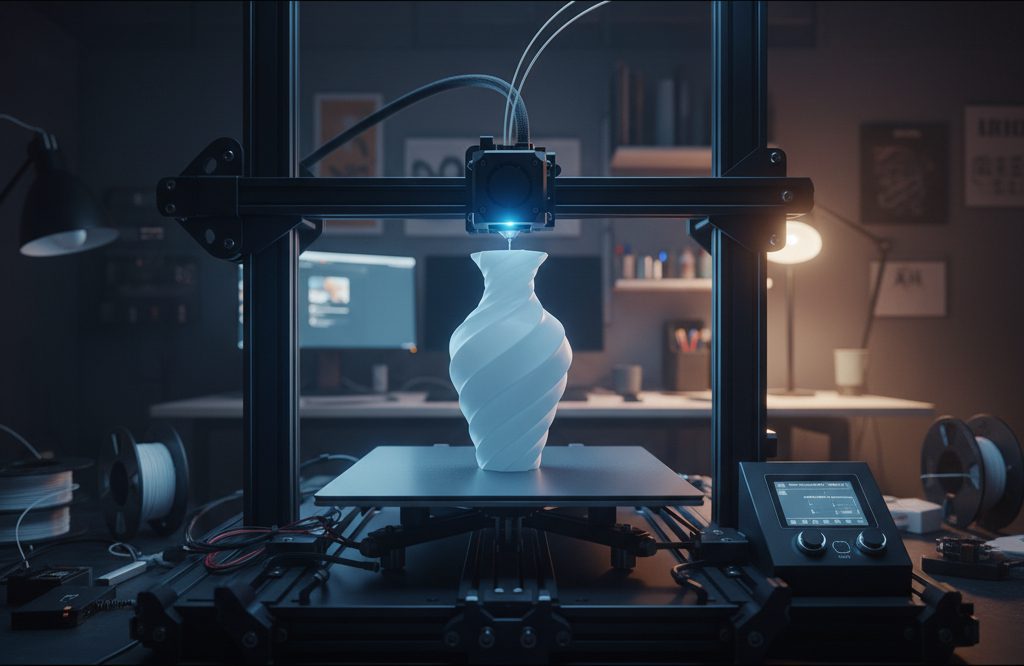
Vases and decorative objects: fluid lines, geometric patterns, or organic textures impossible to achieve with traditional methods.
Art panels and wall décor: three-dimensional works that blend design and material experimentation.
Functional accessories: custom-made home items combining aesthetics and practicality.
Limited editions: small numbered series, personalized by color, size, or engraving—preserving the value of artisanal exclusivity.
Why It’s Different from Industrial Production
In traditional manufacturing, every item is identical, replicated in thousands of units.
With 3D printing, however, each creation can be customized—maintaining technological efficiency while allowing the expressive freedom of craftsmanship.In summary, 3D printing as digital craftsmanship merges the soul of handmade work with the power of modern technology: each object becomes not just a product, but a unique piece that tells a story of creativity, design, and sustainability.
The Advantages of Sustainable 3D Printing
Choosing products made with this technology means embracing:
Environmental sustainability: less waste, optimized processes, and natural or recyclable materials.
Extreme customization: shapes, colors, and details tailored to individual needs.
Uniqueness: every piece retains the character of craftsmanship while born from advanced technology.
Durability: the ability to select suitable materials reduces waste and replacements.
Conclusion
Sustainable 3D printing is much more than a technology—it’s a new production culture.
It allows us to imagine a future where design, innovation, and environmental respect go hand in hand.
Whether it’s a modern vase, a decorative panel, or a small home accessory, every creation carries the story of a conscious project: an object that unites technology, craftsmanship, and sustainability.